There are professional experiences that fade the moment the screen turns off or the office door closes. And then there are others that quietly settle into memory because they make visible what usually remains invisible: how we communicate, how we solve problems, how we listen — or fail to.
Cooking together as a team belongs to that second category. Not by accident. Cooking requires coordination, rhythm, attention to detail and shared decision-making. When a group steps into a kitchen to create something together — and does so through a sustainable lens — something ordinary becomes meaningful. That is, in essence, what sustainable team building is about.
And if there is one city where this approach feels especially natural, it is Barcelona. Here, gastronomy is not an accessory to culture; it is culture. Cooking together, away from meeting rooms and screens, carries the emotional weight of a real conversation — the kind that can shift direction and deepen trust.
It’s not just cooking: it’s taking the time to observe, feel and learn
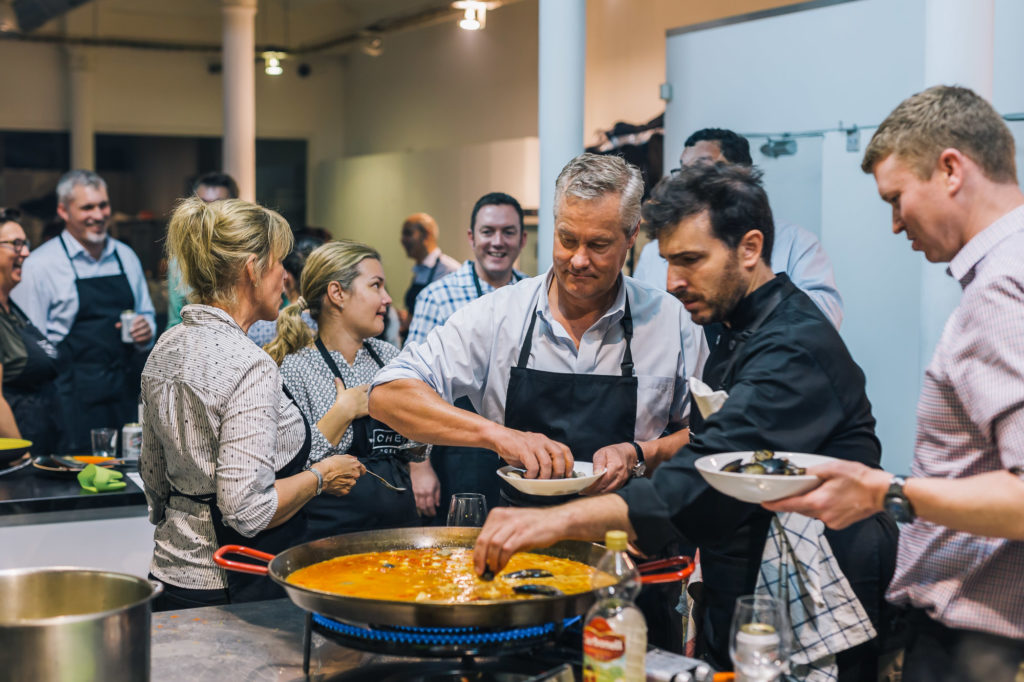
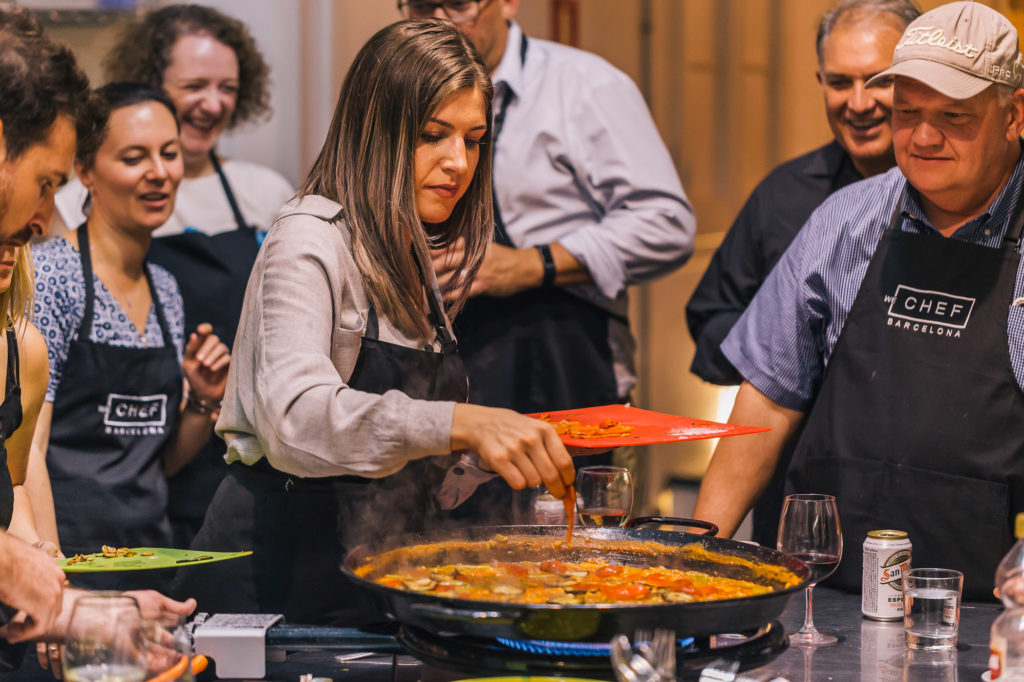
This is not a checklist of trendy ideas. It comes from observing teams gathered around a paella pan, noticing how glances are exchanged when something unexpected happens, hearing how decisions are negotiated in real time.
In the following sections, we’ll explore:
- What sustainable team building truly means — and why it matters today?
- How collaborative cooking mirrors real team dynamics?
- The difference between a meaningful experience and a decorative activity.
- How to design corporate culinary experiences that actually resonate?
- The practical questions that arise — and honest answers grounded in experience
If you’re here because you want your team to live something that genuinely matters, this is written with you in mind.
Sustainability: something you practice, not just declare
When every decision carries weight?
Sustainability has become a familiar word in corporate conversations. But there is a world of difference between saying it and living it.
An eco-friendly team cooking event does not revolve around labels or marketing slogans. It begins with thoughtful choices: selecting local ingredients, respecting seasonal cycles, working with products that have a story and a traceable origin.
It continues with mindful use — planning quantities, reducing waste, valuing every element of the ingredient.
And something subtle happens when a team experiences this firsthand. They realize that every decision — what to use, how much to use, when to adjust — has consequences. On flavor, on efficiency, on results.
The kitchen becomes a tangible metaphor for responsibility.
The kitchen as a reflection of team reality
Invite a group to cook together, and you invite them to rehearse the very skills they need at work: coordination, communication, adaptability and trust.
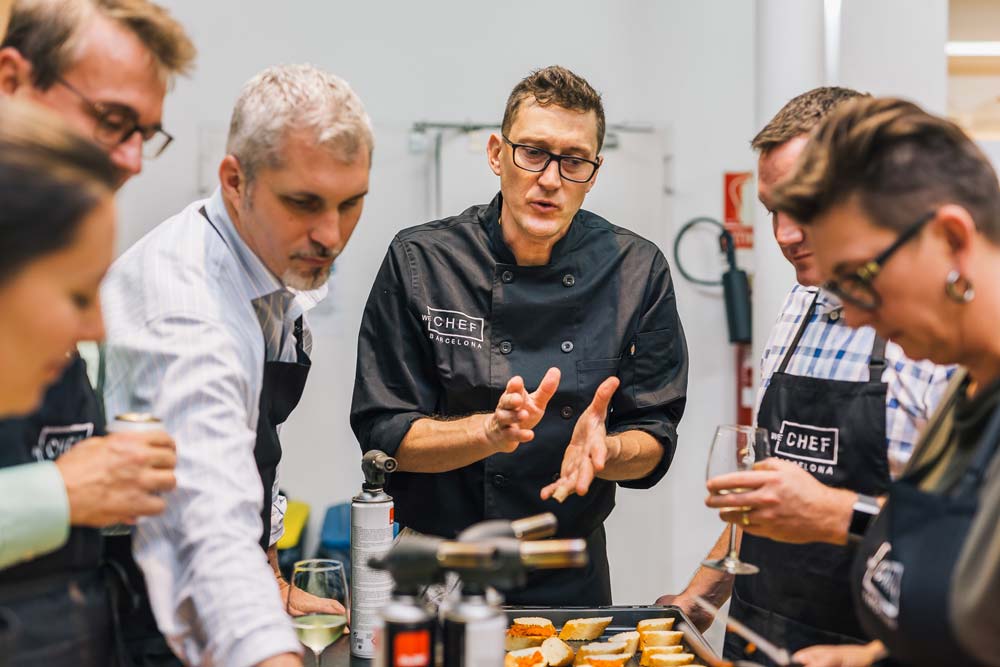
In formats such as the paella and tapas activity, this dynamic becomes visible almost immediately:
- One person organizes the preparation.
- Another manages timing and heat.
- Someone else focuses on presentation.
No hierarchy is announced — yet roles naturally emerge.
And that’s when something valuable unfolds: leadership surfaces organically. Not because it is assigned, but because someone steps forward. Communication sharpens because clarity becomes essential. Collaboration stops being theoretical and becomes practical.
As one team leader recently reflected after a session:
“It wasn’t just about cooking. It was about learning how to listen when no hierarchy was defining the conversation.”
That kind of insight is difficult to achieve inside a conference room.
What makes it truly different from a standard corporate activity?
The distinction may appear subtle — but it isn’t.
A traditional cooking event can be enjoyable. People laugh, eat well and return to work satisfied. But a sustainable team building experience is designed with intention from the very beginning.
Intention as the invisible structure
Every element serves a purpose:
- Ingredient selection reflects values.
- The activity format reinforces collaboration.
- The narrative around sustainability sparks awareness.
- Reflection moments connect experience to daily professional life.
This structure transforms an activity into a meaningful corporate tool.
Challenge combined with responsibility
In experiences like the paella competition, the competitive element adds energy — but sustainability remains central. Teams compete not only for flavor or presentation, but for smart resource management, coordination and creativity.
The result? Decisions become deliberate rather than reactive. Teams think twice before acting. And that awareness strengthens the learning process.
How to design sustainable team building activities in Barcelona?
Start with the “why,” not the menu
Before choosing a recipe, ask yourself:
- Do we want to improve communication?
- Strengthen trust?
- Encourage shared leadership?
- Celebrate a milestone in a meaningful way?
Clarity of purpose defines the format.
Choose the right structure
Not all teams thrive under the same dynamic.
- A collaborative workshop encourages open dialogue and shared creation.
- A structured competition introduces energy and healthy pressure, ideal for groups motivated by challenge.
Barcelona offers a privileged setting for sustainable team building activities Barcelona, combining Mediterranean culinary heritage with modern professional infrastructure.
Make sustainability tangible
There is no need for long speeches. Instead:
- Select seasonal, local products.
- Encourage efficient planning.
- Highlight the story behind each ingredient.
- Foster small reflection moments before or after the cooking process.
Sustainability becomes something the team experiences directly — not just something they hear about.
The long-term benefits beyond the kitchen
Organizations investing in eco-friendly team cooking events often notice:
- Improved internal communication.
- Recognition of natural leadership dynamics.
- Stronger cross-department relationships.
- Alignment between ESG commitments and internal culture.
More importantly, teams carry back shared stories. Those stories translate into trust. And trust translates into performance.
Frequently asked questions about sustainable team building
Is sustainable team building suitable for all types of companies?
Yes. Whether you are a startup or an international corporation, collaborative cooking adapts naturally to different corporate cultures.
Do participants need cooking experience?
Not at all. Activities are structured so that everyone can contribute meaningfully, regardless of skill level.
Can this work for large teams?
Absolutely. Groups can be divided into stations or smaller teams, ensuring active participation while maintaining cohesion.
What concrete outcomes can companies expect?
Enhanced communication, stronger collaboration, improved morale and a deeper internal understanding of shared values.
How does it connect to ESG strategies?
By translating sustainability from policy into practice. Teams live the values the organization promotes.
Cooking with impact: a meaningful way to build teams
Some experiences are quickly forgotten. Others shape how people relate to each other long after they end.
Cooking together — consciously, responsibly — belongs to the second category. It combines technical skill, creativity and collaboration in a way that few other activities can replicate.
In Barcelona, where gastronomy and culture intertwine effortlessly, this type of sustainable team building feels both authentic and powerful.Because in the end, cooking with impact is not just about preparing a dish.
It is about learning to create something meaningful together — and carrying that spirit back into everyday work.